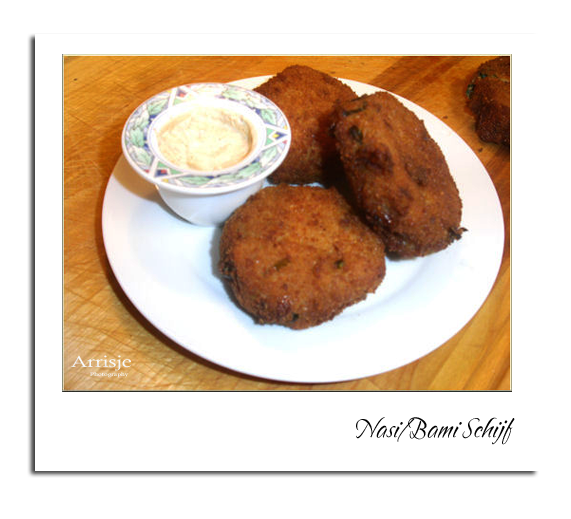
Bami Schijf (Dutch)
Bami schijf or Bahmi schijf Is a tweaked form of an Indonesian noodle dish (bahmi goreng) that was made by the Dutch. Think little breaded pockets of portable stir-fry 🙂
From My Kitchen to Yours .....
Bami schijf or Bahmi schijf Is a tweaked form of an Indonesian noodle dish (bahmi goreng) that was made by the Dutch. Think little breaded pockets of portable stir-fry 🙂

Sate Babi, Satay (also written sate) is a dish consisting of chunks or slices of dice-sized meat (chicken, mutton, lamb, beef, pork, fish etc) on bamboo skewers, which are grilled over a wood or charcoal fire, then served with various spicy seasoning (depends of satay recipe varients). Satay may have originated in Java or Sumatra, Indonesia, but also popular in many other Southeast Asian countries such as Malaysia, Singapore, Philippines, and Thailand, as well as in the Netherlands which was influenced through its former colonies. Sate Babie or Pork Satay, Is a popular delicacy among Indonesian Chinese community, whom most of them are not Muslims who prohibit eating pork. It can be found at Chinatowns in Indonesian cities, especially around Glodok, Pecenongan, and Senen in Jakarta area.

We all heard of the Velveeta Rotel dip, in my opinion this one is way better then the Velveeta Rotel dip. My niece Karlesha told me what was in her crack rotel dip. I made it similar like hers but added pico de gallo. Once you taste this dip you will understand the name:) It is that good you can’t stop eating it. Someone said it was like crack, they couldn’t stop eating it…hence the name:). You can eat it cold or hot.

Pico de gallo can be used in much the same way as other Mexican salsas, Kenyan Kachumbari or Indian chutneys, but since it contains less liquid, it can also be used as a main ingredient in dishes such as tacos and fajitas.
In some regions of Mexico, a fruit salad (watermelon, orange, jicama, cucumber and sometimes melon and papaya) tossed in lime juice and hot sauce or chamoy and sprinkled with a salty chili powder is also known as pico de gallo; it is a popular snack and usually sold outside schools, while the tomato-based condiment is better known as salsa picada, which means minced or chopped sauce, salsa bandera or salsa mexicana, because the colors red (tomato), white (onion), and green (chili) are the colors of the Mexican flag.
One of the sources for the name “rooster’s beak” could be the beak-like shape and the red color of the chilis used to make it. According to food writer Sharon Tyler Herbst,it is so called because originally it was eaten with the thumb and forefinger, and retrieving and eating the condiment resembled the actions of a pecking rooster.
Another suggested etymology is that pico is derived from the verb picar, which has two meanings: 1) to mince or chop, and 2) to bite, sting or peck. The rooster, gallo in Spanish, is a common metaphor for the hyper-masculine (“macho”) male in Mexican culture. One example of such machismo is taking pride in withstanding the spicy burn of chilis.
However, neither theory can be considered definite, as they assume the use of hot chilis. In many regions of Mexico the term “pico de gallo” refers to any of a variety of salads, condiments or fillings made with sweet fruits, tomatoes, tomatillos, avocado or mild chilis — not necessarily with hot chilis, or any chilis at all. Thus, the name could be a simple allusion to the bird feed-like minced texture and appearance of the sauce.
The source of this article is wikipedia, the free encyclopedia.

A frikandel (plural frikandellen) is a Dutch snack, a sort of minced-meat hot dog,developed in 1959.
It is a long, skinless, dark-coloured sausage that is eaten hot. Unlike other sausages, a frikandel is deep-fried. Sometimes it is served on a bun and is then called a broodje frikandel. In Belgium it is mostly called a “curryworst”. Due to the absence of skin, one could argue that it technically isn’t a sausage.
In the Netherlands, Belgium and Curacao, the frikandel mainly consists of a mixture of pork, beef, chicken, and by some manufacturers, horse meat.
It is usually served with curry ketchup sauce and/or mayonnaise, though some people eat it with tomato ketchup. A frikandel with mayonnaise, curry ketchup sauce and chopped onion comprises a frikandel speciaal. The frikandel speciaal usually has a deep cut in the middle to provide room for the chopped onions and the sauces. For best results, the cut is made before frying the frikandel.
In many other countries, including South Africa, Denmark and Germany, frikadel or frikadelle (not to be confused with frikandel) is the local name of minced-meat meatballs or patties like those used in hamburgers.
It took me a while to get this the way I wanted it. From what I have been told it taste just like at home 🙂
I used to roll them which was a major pain, they used to fall apart when I was boiling them. Then I came on this idea, hey why not use somekind of a tube and stuff them. So I went to the local hardware store and bought 2″ diameter pvc tube. Ask them to cut the tube in 7 1/2″. Don’t be surprised when they ask you:”what do you need that for?” Well you can imagine how surprised they were when I replied :”I am making frikandellen ……” I think they only heard part of the word freak lol. Initially I had bought them in 1″ diameter and that didn’t work for me that would give me the size of a hotdog, and you don’t want that because if you are like me you want to slice them in the middle and add the onions, mayo and curry ketchup.