Ingredients 4 medium baking potatoes 1/2 pack of an (8-ounce) package cream cheese, at room temperature ½ cup (1 stick) butter, softened 1 pint Greek yoghurt or sour cream 1 cups shredded cheese of your choice 1 cloves garlic, minced 1 tsp salt ½ teaspoon …
Ingredients Porkloin 1 cup of all purpose flour 2 cups of bread crumbs 2 eggs 1 tbsp water Season all tomato Bibb lettuce German Broetchen Ziploc bag Instructions Turn the deep fryer on to 375F. Cut the pork loin in medallions. Put the pork in …
Where does the word Schnitzel come from? The word Schnitzel is believed to come from the word der Schnitz which means a slice or a cut, similarly Schneider means a tailor. The Schnitzel, by definition, is made with veal. However, today many German restaurants will offer a “Schnitzel” using different meats while still following the preparation techniques of the Wiener Schnitzel (dipped in flour, egg, and bread crumbs, and fried in butter or oil to a golden brown). You may see this called “Wiener Art,” meaning it was prepared like a Wiener Schnitzel, but the meat is not veal.
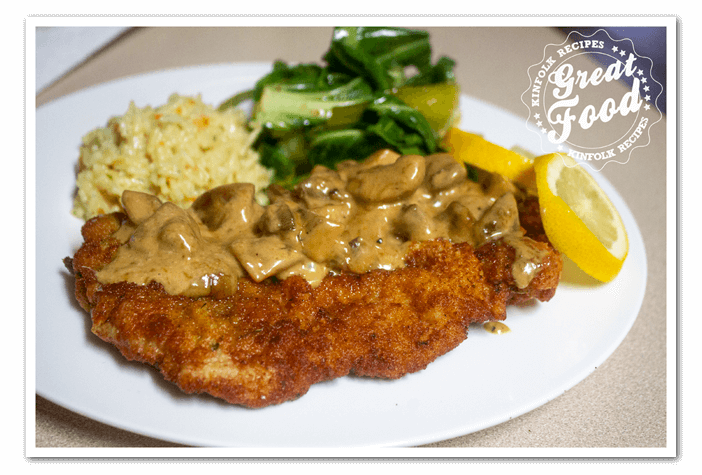
Since veal is not readily available here I make mine with pork loin. This is not only a dinner dish you can also eat as a lunch dish Schnitzel Sandwich
Ingredients
Pork-loin 1 cup of all purpose flour 2 cups of bread crumbs 2 eggs 1 tbsp water Season all 1 lemon Ziploc bag For the Sauce: 1/2 stick of butter 1 tray of mushrooms 1/2 cup leftover wine 1/4 cup chopped parsley pepper 1 cup of heavy cream
Instructions
Turn the deep fryer on to 375F. Cut the pork loin in medallions. Put the pork in a Ziploc bag and pound till thin. Have 3 bowls ready one with the flour, one with the breadcrumbs and one with the egg wash. To make the egg wash add 1 tbsp water to the eggs and whisk. Season the medallions with season all. Dredge the pork loin in the flour, then the egg wash, and last in the breadcrumbs.
The meat is pounded thin so this does not take long to fry, about 3 minutes. Fry in a 375F till golden brown.
To make the Rahm Sauce. Cut up the mushrooms. Add 1/2 stick of butter to the hot skillet and add the mushrooms. When the mushrooms are done add 1/2 cup of leftover wine of your choice, no need to open a new bottle ;). Wait till the sauce is reduced.
Add the heavy cream, black pepper and chopped parsley. Serve the sauce over the Schnitzel. And add a slice of lemon. Squeeze that over the Schnitzel.
Schnitzel, Rahm
Where does the word Schnitzel come from? The word Schnitzel is believed to come from the word der Schnitz which means a slice or a cut, similarly Schneider means a tailor. The Schnitzel, by definition, is made with veal. However, today many German restaurants will offer a "Schnitzel" using different meats while still following the preparation techniques of the Wiener Schnitzel (dipped in flour, egg, and bread crumbs, and fried in butter or oil to a golden brown). You may see this called "Wiener Art," meaning it was prepared like a Wiener Schnitzel, but the meat is not veal. Since veal is not readily available here I make mine with pork loin. This is not only a dinner dish you can also eat as a lunch dish Schnitzel Sandwich Schnitzel Sandwich
Turn the deep fryer on to 375F. Cut the pork loin in medallions. Put the pork in a Ziploc bag and pound till thin. Have 3 bowls ready one with the flour, one with the breadcrumbs and one with the egg wash. To make the egg wash add 1 tbsp water to the eggs and whisk. Season the medallions with season all. Dredge the pork loin in the flour, then the egg wash, and last in the breadcrumbs.
The meat is pounded thin so this does not take long to fry, about 3 minutes. Fry in a 375F till golden brown.
To make the Rahm Sauce. Cut up the mushrooms. Add 1/2 stick of butter to the hot skillet and add the mushrooms. When the mushrooms are done add 1/2 cup of leftover wine of your choice, no need to open a new bottle ;). Wait till the sauce is reduced.
Add the heavy cream, black pepper and chopped parsley. Serve the sauce over the Schnitzel. And add a slice of lemon. Squeeze that over the Schnitzel.
Ingredients 1 can black-eyed peas 1/2 english cucumber 1/4 cup finely chopped red onion 2 medium tomatoes, seeded and chopped 1 medium jalapeño pepper, finely chopped 1/2 cup chopped fresh cilantro if available 2 cloves garlic, minced 1/4 cup fresh lemon juice (about 2 large …