Spanish Rice

Spanish Rice

Spanish food is quite different from that of many other European countries in that it makes heavy use of rice; a staple that is more commonly associated with Asian countries. In order to understand exactly why the Spanish use rice so much in their cuisine it is beneficial to recount the history of Spanish rice. Spain was ruled by the Moors, who in turn were heavily influenced by the cuisine and culture of Muslim Arabs form the Middle East. It is widely believed that it was the Moors who laid the foundation stone in the history of Spanish rice by introducing it to the local population. By the time the Moors were expelled from Spain more than 700 years after they first arrived, rice had already developed a long established history among the Spanish people who were not prepared to abandon it.

The fact that rice came to the Spanish from the Moors is supported with linguistic evidence. The Spanish word for rice is ‘arroz’ which seems to come directly from the Arabic word for rice which is ‘al- ruzz’.

Spanish Rice Today

Today the term Spanish rice is often used to denote a specific dish that is served as a side dish made from white rice, tomatoes, garlic, onions, parsley, cilantro as well as a few other ingredients. One common cooking method for Spanish rice is to saute the rice until golden brown and cook it in chicken broth. Vegetables including carrots and peas or corn may also be used depending on the recipe.

Spanish rice is a popular dish in the Southwest of the United States, where it often features liberal portions of grilled and stewed vegetables. The version of Spanish rice cooked throughout South America tends to be more standardized, often with just enough tomato and chili to provide the characteristic reddish orange color and a smoky, garlic and onion taste. It is frequently served as a side dish alongside other Venezuelan and other South American Cuisine.

Stoof Peertjes (Dutch)

Stoof Peertjes (Dutch)

It is about time I start to post some recipes of my child hood. Recipes of the food my mother used to cook for us and still does. The picture below shows some shots of her well used cookbook :).

If you are Dutch you know what this is. This is a typical Dutch dish. I had to improvise with this recipe for stoofpeertjes, because some ingredients are not available here, like ‘Gieser Wildeman Pears’, I used Bosc Pears. Bosbessensap is not available here neither. I came up with one of my own concoctions.

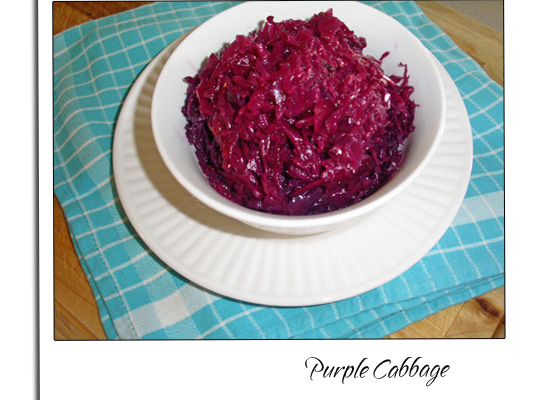
Purple Cabbage (Dutch)

Purple Cabbage (Dutch)

Red, Purple Cabbage: cabbage gets its color from a pigment called anthocyanin as do all red, blue, and purple plants. Red cabbage was even grown in the Middle Ages when botanists learned to encourage its special color feature.

In its raw state, cabbage contains iron, calcium, and potassium. High marks are given for its vitamin C content. Cabbage is also high in vitamins B1, B2, and B3. Lengthy cooking tends to lower the nutritional value considerably.

Red cabbage is higher in fiber than green, with 4 ounces of it boiled and drained offering 2.7 grams. It’s higher in vitamin C, offering 25.8 milligrams for 4 ounces cooked. Red cabbage is also higher in calcium, iron, and potassium than its green cousin.

Savoy and napa cabbage can boast they contain 20% of the RDA for vitamin A, while red and green cabbages contain considerably less. Bok choy contains the most vitamin A, supplying 60% of the RDA, although it is equal to red and green cabbage in other nutrients.

Pickling is an excellent way to preserve the vitamin C in cabbage. In fact, Captain Cook attributed his crew’s good health to a daily ration of sauerkraut.
Purple Cabbage: (Rode Kool) Is another recipe of my mom, this is the kind of food I grew up with. The pictures are not doing justice to this easy recipe.

Cornbread Dressing

Cornbread Dressing

Living in the South means you will always have cornbread dressing at every holiday dinner. Of course you can make this dish any time you have a taste for dressing. The first time I had the pleasure of eating dressing was at my sister in law’s house. I got the general recipe from my Mother in law Farrie. When I would ask her how to make it, she would say: ” a lil of this and a lil of that” :). It took me some time to perfect it, to the way I make it today.

The Best Collard Greens you will ever Make

The Best Collard Greens you will ever Make

Collards, also called collard greens or borekale (Brassica oleracea Acephala Group), are various loose-leafed cultivars of the cabbage plant. The plant is grown for its large, dark-colored, edible leaves and as a garden ornamental, mainly in Brazil, Portugal, the Southern United States, many parts of Africa, Montenegro, Spain and in Kashmir as well. They are classified in the same cultivar group as kale and spring greens, to which they are extremely similar genetically.